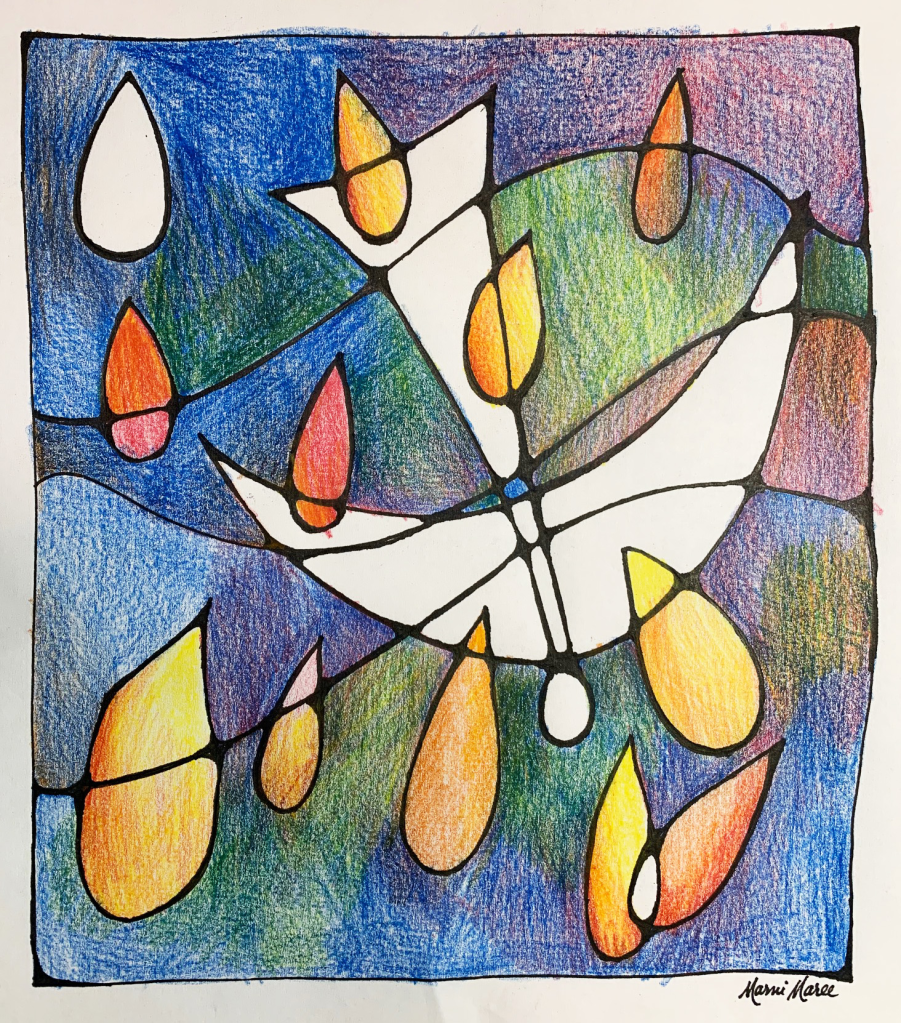
On Pentecost.

Art by Marni Maree

Sunday is Pentecost Sunday (note: some churches will celebrate next week based on their calendar). It’s a day the Church has marked for as long as there has been a Church. 

It remembers the followers of Jesus spilling out into public, empowered by the Spirit of God, proclaiming “the wonders of God.” It remembers people from different nations hearing these proclamations in their own tongue. It remembers the long-given promise that God is for all people, everywhere, regardless of gender, age, culture, status, or any other category humans divide around.

Pentecost is a foundational day and story in the life of the Church. It will be celebrated in Haiti and Uganda and China and Australia and Iran and every space in between, in every language and possible worship expression, in large cathedrals, small living rooms, and cold jail houses.

And Sunday large swaths of the North American Church will instead order their gathering around the praise of a nation. Because it’s also Memorial Day weekend.

Hear me: my contention is not that we shouldn’t honor those who have died in service to a country, it’s that too many branches of the family tree have gotten the stories out of order.

They will gather and pledge allegiance to flags and declare “God Bless America” while forgetting our allegiance is to the borderless Kingdom of God and God’s dream is that “all peoples on earth will be blessed through you.”

Sunday is meant to be a celebration of what God did and does to draw all people together. Monday can be a day for honoring our fallen. Sunday should be the day we tell the story about a line-erasing God who empowers people to cross border and boundary and bias in order that all can belong. 

Maybe you’d argue we can do both at the same time, but from what I see in our current moment, we cannot. 

I watch as people who claim to follow Jesus cheer, champion, or dismiss cruelty and hardship against neighbors because they lack the right paperwork. As suspicion and disdain grows of anyone who doesn’t look, act, talk, vote, believe like they do. As people meant to spend their life in service to others grasp at every possible (and often vile) means to cling to privilege and power. And then fool themselves by baptizing it with prayer and a loud “Amen.”

I’m not anti-Memorial Day. Or anti-American. I’m anti-idolatry. I’m anti confusing the story of the nation with the story of our faith. I’m anti trading what is most true for a lesser truth.

I myself am often tempted to stay from the path. I need reminded what is most important. I need shaped into the person I’m meant to be rather than person I default to. I need religious formation and practice and expressions that stretch my attitudes and ethics to look more like Jesus. I need the Church to be the Church so I can be more faithful.

And by Church I absolutely mean the capital C, big and broad and messy and beautiful and ancient and new and too often getting it wrong people who have found life and meaning on the way of Jesus. I need us to remember who and Whose we are, long before any republic or president or treaty or bank statement or political platform or citizenship. 

This is the most true story. And we need to tell it. We need reminded. We need re-formed. We need the Spirit of God to once again push us out and beyond our comfort and complacency and culture to a world hungry for belonging and joy and peace and grace. 

We cannot settle for a patriotic Christianity when we’ve been called to a Pentecostal one.

There is a better way. And if we can be the Church we are called to be and be formed in the ways we are meant to, then it won’t matter what country we find ourselves in or what leaders have power: we will be better citizens and neighbors because we’ve been shaped by the God who calls people from “every tribe, tongue, and nation.”

So this weekend gather and remember the story of our untamable, shows-up-in-wind-and-fire God. Remember you belong to a story truer and richer than the one that started in 1776. Remember you belong to a people more real than even the ones you share DNA with and certainly more than those you share political views or legal status with. Remember that you are called to something wider and higher and deeper and more transformational and eternal.

May this weekend bring you into further alignment with the God who will not be possessed. May you find yourself stretched and pushed and reminded about the most true story. May your religious expressions form you into the image of Christ more than any other. And may you and all people everywhere know you are beloved, desired, and welcome at the local church, around the table, and in the world God dreams of. 

On Herod(s).

Herod the Great

In the Gospel of Matthew, magi, or wisemen, travel to find one they call “the newborn king.” They show up at the palace, where you might expect to find such a person, and their words trouble Herod the Great. He already holds that particular title.

The sitting monarch says, “When you’ve found him, report back to me so that I too may go and worship him.”

Of course he intends no such thing. In fact, he will go on to command the slaughter of every Jewish male two and under in Bethlehem, just in case.

Which is a story as old as time – people using feigned devotion for their own ends. Herods ancient and modern who seek only their own enrichment and a tighter grip on power. Who will lie to your face and trample any and every one in their way. Who use religious lip service and symbols in hopes of placating the faithful. Who think sprinkling in “God bless America (or Judea or Rome or Babylon or Britain)” sanctifies their ill intent.

Herod was a liar. He still is. He still shows up in places of power: podiums and pulpits and profit centers in particular. He shows up when people need you to believe one story while they live something very different. He shows up in people who need you to not ask too many questions or peak behind too many curtains.

But Herod’s falsehoods are only as effective as we let them be. We can, like the magi, go a different way. We can refuse to settle for hollow platitudes. We can draw lines around our values and not trade them for trinkets and empty promises or access to power. We can refuse to comply or pretend or look the other way.

We can look instead at the body of evidence. At the values being lived out, not just the sound bites. We can insist that our senses must line up together. We can, and should, demand better of every person who has authority in our world.

And we can and should always reject Herod and his ways, wherever they might show up, pretend to care, or say all the right words while smiling their fake smiles. 

Heord’s false piety was meant to cover up the stench of death. It still is today. 

May we have the insight, courage, and audacity to know better.

On words.

The President of the United States spends his time calling people names.

Sometimes he drops slurs like the “r-word” on Thanksgiving – a word that has risen in popularity since his inauguration. Sometimes it is to call a reporter names when asked questions he cannot or will not answer. Sometimes it is directed at people on the margins of society. Always it is directed at those who don’t support him or dare question him (even if they once worked with or for him).

All of it is beneath the office. None of it would be allowed in my work place. Or the schools my kids attend. Or in most people’s living rooms.

And no, it is not strength – it is weakness. It is not “saying it like it is.” It is immature, willful insolence and it is how Donald Trump has acted for as long as you’ve known his name.

It’s not “just words” either. It is dehumanizing and dangerous language. And, for a person who claims faith in Jesus, “it’s just words” is an explicitly anti-Christ argument.

The current President lacks character and decency. We know this (or did until he became the nominee in a broken 2 party system). It shows up over and over again, in more than just words, but in words loudly and often.

Maybe you like some of his polices. I’d suggest there are others who could implement those things. Or perhaps that the policies championed by a person who never matured past middle school playground bullying may be just as problematic.

I’d also suggest the options are not binary. You don’t have to choose between either accepting (or condoning [or parroting]) awful behavior and Communism/Socialism/Anarchy/Whatever you fear. You have power in this process. You can speak up and say, “I support X, Y, and Z, but I cannot support this.” You can ask elected leaders, even ones you vote for or share a party affiliation with, to do better.

Criticism or accountability for people we usually support is a practice in freedom and integrity. And if you belong to the Church and typically (and/or publicly) support this administration, I’d suggest there is a world (including myself) desperate to hear you speak one word of pushback on the things we are seeing and hearing from the President.

The roaring silence sounds a whole lot like approval and applause.

Words matter.
Decency matters.
Character matters.
Power without character is deadly.
Wealth without character is bankrupt.
A nation without character is lost.
And certainly a Church without character is an abject failure.

We can and must be better.