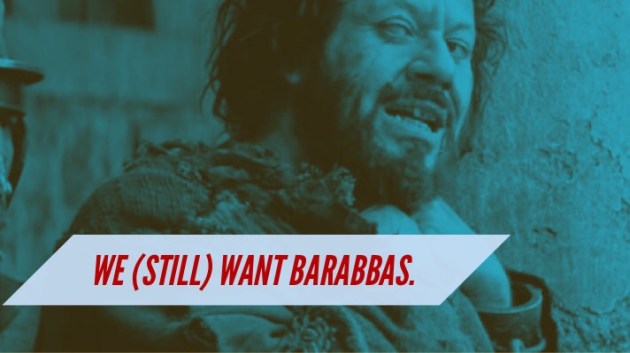
We (Still) Want Barabbas

img_7179Some choices are easy.

Salad or ice cream? Fajitas or anything? All expenses paid vacation or work?

Other choices are hard.

Move or stay? Keep going or give up? Take a risk or play it safe?

Whether easy or hard, the choices we make often reveal who we are and what we value (In my case: ice cream, fajitas, and trips to the shore).

In the events leading up to the crucifixion of Jesus we encounter a pivotal moment. There is a choice to be made.

Scripture tells us it was customary to release one prisoner in honor of the Jewish Passover. This generosity was intended to pacify the large crowds gathered in celebration.

This year the governor gives them a choice: a man who stands accused as a murderous revolutionary or one who is accused of blasphemy.

The supposed blasphemer is the man we know as Jesus of Nazareth, also called the Son of God. The revolutionary is named Jesus Barabbas, which literally means Jesus, Son of the Father.

The crowd gets to pick their Jesus. To decide which son they prefer: the mercenary or the Messiah.

They make their choice.

Jesus of Nazareth will be beaten and executed. The people want Barabbas.

And us, all these years later, we (still) want Barabbas.

When given the choice between the mercenary and the Messiah we often choose the wrong Jesus. We may say all the right things and claim the right beliefs and have the right bumper stickers, but the way we do politics and conflict and church and relationships and whatever else reveals who we have really chosen.

We still want the violent insurgent.

We, like the crowd that day, have little patience for the slow Kingdom coming.

We want movers and shakers. Those who get things done.

Those who cause our enemies to tremble.

We have no time for a Kingdom that is like a mustard seed, small and slow and making its way little by little. We prefer kingdoms of tanks and trains: get on board or get run over.

We want to be first, not last. To be catered to, not to serve.

We want conquerors on stallions, not peacemakers on donkeys.

We want people to pay. To get what they deserve.

We have little use for mercy. And no use for meekness.

We want brash and bold and big.

We still want Barabbas.

Sure he is a edgy. And sure he has a shady past. And questionable morals. But he is with us. He fights for our rights. It’s not like we want him to be a priest or anything.

We know where he stands and he says it like it is.

Give us Jesus, the mercenary one.

We want the Jesus who will rid us of our foes. Who isn’t afraid to throw some elbows and shed some blood.

We want power. We want to call the shots. We want to be sit where Caesar sits because we are convinced Caesar’s way is the only way.

The other Jesus? He prays for his enemies. Instructs his followers to love them even. He tells us to control our tongue and not to insult others. He says to care for the poor and sick and he hangs out with people who have no clout in society. He says the way up is down. He says not to repay evil with evil. He washes other people’s feet. He lets people spit on him.

This isn’t how we win.

Give us Barabbas.

We’d rather fight alongside the scoundrels than be crucified with the holy.

It is pretty clear which Jesus we choose most often. And what things we value and who we really are. And the truth is not pretty.

Too often I am more a Barabbas-ian than a Christ-ian.

Too often the choices I make look more like the kingdoms of this world than the Kingdom of God. Too often I can’t even imagine any other way of doing things.

I want mine. I want it now. End of story.

The way of Jesus Barabbas feels quicker. It looks sexier. It looks like it is working for the other side.

But this is the not the way. When it comes to what matters most, shortcuts only lead to dead ends.

This is not the Jesus that leads to life.

The other Jesus, the one from Nazareth, will show us the way. He will invite us lay down our swords and to lay down our lives. He will invite us to trust, to have faith that this is the way to lasting victory. He will demonstrate a love that has the power to change lives and hearts and worlds.

And when this way and this Jesus look completely defeated and hopeless. When it is stripped naked and beaten and gasps one final breath. When this way is laid in a grave and left to rot.

We will learn that this way is just getting started.

May we have the patience to avoid the shortcuts. May we have the ability to imagine a better way and a better Kingdom. May we choose the right Jesus. And may we find life now and forever and abundant. Amen.

Breaking Up On Purpose

broken heart

Image Source: Spectator Health, UK.

One of my middle school friends was broken up with today. He is a basketball star, she is one of the cool kids. After a couple weeks of dating that consisted of little more than sitting together at lunch and texting after school, he was convinced she was the love of his life.

He loved her with his whole 14 year old heart.

Now, you and I know better. We know this was infatuation. We who have the wisdom of years know that love is more than butterflies and more than the excitement of reciprocated attraction.

But the pain my friend is feeling is real. Even though this was not a deep, committed love, his heart is breaking for the loss of relationship. It stings.

And this sting of the heart is the invitation in season of Lent. We are invited to let it hurt.

On purpose and for good cause.

Lent often begins with a call from the prophet Joel:

Yet even now, says the Lord,
return to me with all your hearts,
with fasting, with weeping, and with sorrow;
tear your hearts
and not your clothing.
Return to the Lord your God,
for he is merciful and compassionate,
very patient, full of faithful love,
and ready to forgive. Joel 2:12-13

Those of us who are human have a tendency to get our hearts caught up in things that are not full of love. Not real love. At least not the faithful love of God.

We are captivated by cute and shiny things, much like middle schoolers. We are enamored with mutual attraction. We like being liked. The butterflies, the status it brings, the fun of young love infatuation.

Unfortunately, these infatuations are not as innocent as they were in middle school. They distance us from God and God’s desires for us. They cheapen our commitments to each other. They fill us with empty things. They call for our allegiance. They distract. They numb. They consume. They block out any conviction that might otherwise call us back to the right path. 

They tell us we are loved and they ask for our whole hearts. The first part is a lie and the second is a death sentence.

What starts out as a fleeting middle school romance quickly turns into full fledged idolatry and adultery. What seemed fun and harmless becomes the thing that destroys our faith, our witness, our church, and/or those we most care about.

And so in Lent we take the time to ensure this is not happening to us. We do the hard work of breaking our own hearts. Of examining where and to what we give our attention. We break up with our crushes even when our crushes look like everything we’ve been searching for. Even when it hurts.

More than just ripping our clothes (an ancient act of sorrow) or going to a worship gathering or saying “I’m sorry” or jumping through the next hoop, we rend and rip our hearts. We get in there where it stings and we let it make us uncomfortable.

We let it sting believing that the sting teaches us. It reminds that these things (whether good or bad) can distract us. It reminds us that they are not truly life giving. It reminds us that God alone is worthy of our whole hearts and allegiance. And it helps us remember just how much work we still need.

Perhaps it is people’s opinions that easily catch our attention. Or maybe its the pursuit of endless pleasure that draws our eye. For many of us it is the allure of power and control. For many it is our allegiance to partisanship that is standing in the way of faithful love.

It can be something as simple as Facebook and as complex as our core identity. Some of these things are new and some of them have been making their way into our hearts for years and years.

The invitation from God for us this day is to, “Return to me with all your hearts.”

The way to ensure we are doing this is to put an end to these other relationships. To break up with (even temporarily) whatever may be in the way of what God wants to do with and through and for us. One typical way to do this is through prayer and fasting. 

Perhaps you and I should abstain from social media for a while. Or political news. Perhaps we could channel the energy we put into politics towards our faith or our family. Maybe we take a break from food or drink, especially when we reach for these things in times of trouble. Maybe its a person. Or a bad habit. Maybe its a break from television that numbs us to death. Or perhaps there is something new we should begin or return to (perhaps a commitment to a faith community) that can help us align our hearts with God.

Whatever it is, however good or bad it may be, we have to put in the work. We need Lent because it is too easy to sit idly assuming that everything we do and and are attracted to is good and godly when there is ample evidence in human history and our very lives that demonstrates this is probably not the case. We need work. Lent is an invitation to allow God to do that work in and alongside of us.

Even when it stings. Perhaps especially when it stings.

My friend will be fine when he realizes this girl wasn’t really the love of his life. Though he hurts today he will be better sooner rather than later. One day he may think how fortunate he is to have not wasted time and energy in this relationship.

May it be so in us as well.

May we have the courage to break our own hearts for the sake of our faith. May we be willing to sit in the sting of heartache long enough to know where true love is found. And may the pain and anguish of a break up turn us back to the God who “heals the brokenhearted and bandages their wounds.” May we find life in response to the death of our middle school crushes.


The Bible and the Border Wall

Do you know what the Bible has to say about a wall on the border between the United States and Mexico?

Absolutely nothing.

Some will tell you that because a man named Nehemiah once built a wall around Jerusalem, God obviously wants a wall on our southern border.

This forgets that in the Bible God instructed a group of people to march around a wall until it fell down.

Some say heaven has a wall and gates so our nation should too. They forget that it says those gates will never close. And what a metaphor is.

Jesus is said to tear down “the wall of hostility that divides us.” Is that a literal wall? Or spiritual? Or both?

Is God pro-walls or anti-walls?

How does the Bible prove or disprove our opinions?

Maybe a better question for us – What if trying to get the Bible to validate our opinions is the problem we need to address?

This isn’t really about The Wall. You can have your opinions about whether or not it is necessary or wise or good. I think we can disagree on this without violating God’s instructions.

The bigger issue is our mutilation of the Scriptures.

Yes, I think we should look to the Bible to help us learn who God is and how God wants people to live. I believe this includes how we do politics.

But when we force the Bible to say what we want, we do damage to its power and its place in our lives. When we search for the perfect Scripture that will simply confirm our positions, we have reduced what we consider inspired, sacred text to little more than an ancient meme.

We become butchers, carving out we like and discarding what seems troublesome.

This is how slave holders defend the practice of owning humans: “Look at this Bible verse here that says slaves obey your masters.”

This is how people justify child abuse: “Spare the rod, spoil the child.”

This is how people sanctify misogyny and segregation and war and anti-Semitism and the slaughter of indigenous people and any such things. They take something out of context because it fits their already held belief. They bend the Scriptures to their will instead of allowing themselves to be changed.

The Bible is messy. It involves all sorts of people with all sorts of hang ups and failures. At times it is downright scary. Sometimes it speaks in ways that are hard to understand in our modern world. Sometimes we find people acting in blatantly evil ways with little or no protest.

If we start with our opinions or our party platforms, we can make a case for a lot of things that are actually counter to God’s desire for the world. When we start with our previously held positions we are putting ourselves or our politics in the position of authority.

This is an insult to God. It is an act of idolatry, setting up self or partisanship as its own god.

We must deal with Scripture faithfully. We must read it in its context and understand it in its original location in history. And we must deal with all of it. What does the breadth of this holy text say?

There may one story about a wall being built and one story about a wall falling down but the arc of Scripture has passage upon passage about how to care for neighbors and immigrants and people in need, whether or not a wall is ever built. That should motivate us far more than a once off story that proves us right and others wrong and really has absolutely nothing to do with our current situation.

The Bible doesn’t point us to a conclusion about a specific security infrastructure along the US border. The Bible points us to Jesus, who is the Word of God. And Jesus is concerned about our heart and how we align our lives.

We start with Jesus. And we allow Jesus to shape and form our worldview and our politics. First.

And we allow it even when it grates against our conservatism or our progressivism. We humble ourselves and turn away from what we think and allow God to challenge us. Even when what we believe feels right. Or even when the Bible doesn’t lay out something explicitly.

The Scripture doesn’t divide out when we should have individual liberty and when we should have communal support. It doesn’t solemnize big government or limited government. It certainly doesn’t speak of the United States or its borders at all.

But it speaks of Jesus and it calls the people of God to follow after him. This is our starting point. This is the lens through which we view all things.

From there we build our worldview and our politic. From there we can see what is essential and what is a matter of opinion. From there we can find ways to be faithful regardless of whether we would have chosen it on our own or not. Regardless of laws or parties or upbringing.

May we stop using the Scriptures as a weapon to defend things that we have decided on long before searching the text. May we allow ourselves to be shaped by God and not force God into our own image. And may we be faithful to the God who inspires the text and the way this God calls us to follow.