Good News for All the People.

I’ve been radicalized to believe that “good news of great joy that will be for all people” is actually true.

That what God wants to do in the world and for the world is truly good. For everyone.

Too often we hear only good news for me and people like me. Good news for those who toe the party line. Or behave. Or those who believe the right things (read: agree with my narrow theological interpretation).

Which often means bad news for those unlike me. And those who interpret the Bible differently. Or doubt. Or behave in ways I don’t. Or don’t fit my preconceived ideas. Or subscribe to another or no faith.

Those of us who believe the story of the first Christmas should ask ourselves, were the angels lying or being hyperbolic when they said it was good news for everybody?

Or when the prophet Isaiah said God will prepare a feast for “all people” and swallow up death and wipe away tears from “all faces,” do you think he actually meant… all the faces?

Or when God told Abram that “all the families of the earth will be blessed” or when the Psalmist wrote “Every part of the earth will remember” and “every family among all the nations” will praise God, was that accurate? When John the Revelator sees every tribe and tongue or says “All nations will come” to give God praise, is that not real?

There are certainly places in Scripture where God showing up sounds like bad news. Where people experience judgement and get what is coming to them. Even in the Christmas story Mary says God “pulls down the powerful” and “sends the rich away empty handed,” which doesn’t sound all that great for them. I could easily compile other examples to say the exact opposite of what I am trying to say.

The question is, which version of events do I believe? Which do I hope for? Which one do I live toward? And which one looks most like the God revealed in Jesus?

What I believe God wants and who I believe God loves and how I believe God works and where I think this world is heading impacts my attitudes, politics, church, spending, biases, and all the other things. In the (fantastic) book Everything Sad is Untrue, Daniel Nayeri says, “What you believe about the future will change how you live in the present.”

Do I believe in a future that is good for all creation? Do I even want to believe in something like that? Can I trust in the goodness of God and rest in the mystery that with justice and grace everything is being made new?

If I can’t, perhaps I become more prejudiced and circle the wagons and view others with suspicion and look down my nose in judgement at those not like me. Maybe I build bigger walls and drop bigger bombs and draw harder lines. Perhaps I announce, in word or deed, bad news for anyone not on my team or anyone who doesn’t look, act, or believe like me.

However, if I see God’s coming as life giving and redeeming for the whole world, if I’m bent toward “good news of great joy for all people,” I will at least find myself walking the path of Jesus, who models again and again the expansive love of God. For lepers and tax cheats and prostitutes and criminals. For zealots and religious leaders and the demon possessed and the pushed to the margins. For insiders and outsiders, foreigners and skeptics, those making a mess and those on whom the mess has spilled.

Perhaps in walking the way with Jesus and longing for the Kingdom of God to be made real everywhere and for everyone, I find myself experiencing things like hope, peace, joy, and love. Perhaps it allows me to drop my defenses and the need for control and the anxiety inducing habit of trying to convince everyone to do and believe what I do and believe. And, just maybe, it makes it harder and harder to exclude anyone, even my enemies.

Perhaps this is when I am most Christlike. And where I find freedom and transformation and salvation.

Good news. Great joy. All people.

Could it be that simple?

In his book Nayeri also says, “Maybe we get the endings we deserve. Or maybe we get the endings we practice.”

What if that is the truth? And what if we and our neighbors actually deserve good? And what if we practiced wiping the tears from all faces and throwing the most inclusive feasts and inviting all the people and offering extravagant amounts of mercy and grace and then in the end find we have practiced our way right into the world of God’s dreams?

What if what happens at Christmas is an invitation to believe that all will be made right? That God is really, truly with us and for us. That everything sad is untrue and the worst things will not be the last things?

And what if that is the message the angels want the shepherds and townsfolk and pagans and religious elite and screw ups and put together and doubters and weepers and burned out and smug and oppressed and kings to really hear?

May we be captured by the deep and real good news of Christmas. May our dreams for the world align with God’s. May all people, all of em’, find exactly everything they possibly need to belong, flourish, and have abundant life. And may we hope and practice for the day when all things will be made right.
The Weary World Rejoices

This year I am weary. Maybe it’s my cynicism flaring up, but I feel the weight of our present reality more acutely than in years past.
I’m worn out by our political climate. I’m tired of the name calling and the line drawing, the hypocrisy and the partisanship. I’m tired from holding my tongue and I’m tired from speaking up (however infrequently). I’m fatigued by our lack of decency and our infatuation with power at any cost.

I’m worn out by the Church too. From our political idolatry for sure, but also our constant bickering over petty stuff. I’m tired of watching people walk away from faith because they were shown an inaccurate view of God. I’m drained by self-appointed gatekeepers intent on keeping people out. I’m worn out by church as entertainment and the pull to chase crowds and celebrity. I ache for congregations doing their best to be faithful in a world that has no time for them. And I’m tired of story after story about how we who are called to bless the world have instead wounded God’s beloved.

I’m exhausted from grief as I see people limp through life. From those who are denied justice to those who have made a mess of things.

I see friends and family and strangers on the internet who carry heavy loads. Who battle trauma and depression and estrangement. I watch as people wrestle with doubt and hardship and diagnoses that suck the life right out of them. People we love and people who are us have struggled in finances and bodies and loneliness and child rearing and every single other thing. It has run us ragged.

I’m tired from the 24 hour news cycle. The constant outrage. The constant apathy. The refugee crisis and gun violence and racism and terrorism and war and suicide and consumerism and all of it.

I’m weary from all the times I’ve blown it and all the times I wish I had chosen differently. I am even tired from knowing I have it better than so many others and my seeming inability to bring about progress.

I am weary.

And yet.

The old song sings, “A thrill of hope, the weary world rejoices, for yonder breaks, a new and glorious morn.”

A thrill of hope that Jesus is here. On our side. At work. Restoring. Redeeming. Re-orienting us.

Despite our brokenness. Despite our shame. Despite our constantly screwing it up and never getting it all right, God is with us.

God sees our mess and moves toward us to show us the way. The way out of and away from all the things that beat us down. A God who comes not to burden us but to carry our burdens for and with us.

A God who comes to the bedraggled and barely making it. To battered souls and threadbare faiths. A God who comes and offers unconditional love and incomprehensible peace even in the midst of all that is wrong.

I believe there will be a day when weariness will be no more and darkness will be banished and justice will roll like a river. I believe in a day with no more sickness or political pandering or shattered hearts.

However far off that day feels, Christmas reminds us that it isn’t out of reach. A better world is on the way. The someday we await is just over there, as close as the next dawn.

The light of eternal sunrise is waking from its slumber. It creeps across the horizon, slowly stretching its warm fingers and chasing away all that is shadow. It will not, can not be held back.

When we look for it we can see it. When we are uncertain we can walk toward it. When we are undone by the weight of it all we can rest in and celebrate the goodness of God’s coming.

Even our longing for rest and wholeness serves as a reminder that God is on the move. With us. When we hurt. When we fail. When we want to crawl into bed and sleep for a decade. When hope feels more like an ache than an excitement.

God is near. The sun will rise. The angels will sing. Our tears will be dried. And life and light will bring all that we need.

So rejoice, weary world. Lift up your head. You are not forgotten. You are not alone. All will be made new. Love has come.

The Gospel of the Magi

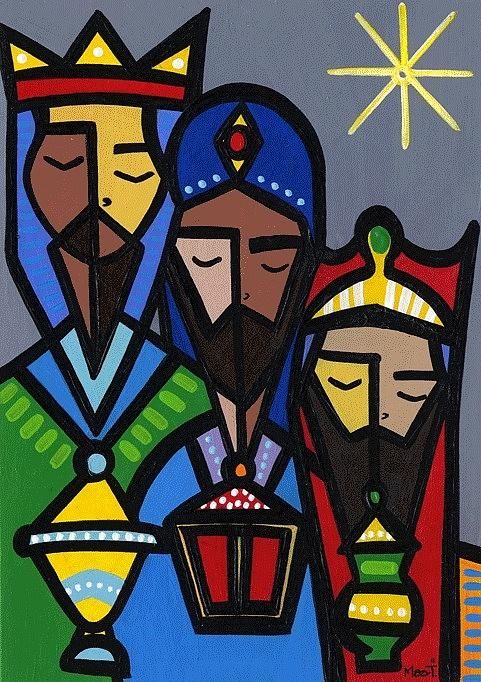
three kings

Three Kings by Mary Tere Perez

Plenty of people have been packing up their Christmas decorations since December 25, but the celebration of Christmas continues for twelve days. It only ends at the Feast of Epiphany on January 6th.

And then at Epiphany we remember the visit of the magi, or the wise men, to young Jesus.

Sometimes we rush past this remembrance as we put away our trees and head to the gym armed with New Year’s resolutions. But we need Epiphany. The magi are essential to the Christmas story and essential to our faith.

They are not essential because they were there on the night of Jesus’ birth (they likely weren’t) or because they were earthly kings who bowed to the one true King (they likely weren’t kings either). They aren’t essential because they round out our  nativity scenes and Christmas pageants and greeting cards.

They are essential because they carry the Gospel. They themselves are an announcement, a proclamation, a living, breathing sermon about who our God is.

See the magi were not Jewish. They weren’t part of the chosen people. They were Gentiles, outsiders. Strangers.

Worse, they were likely priests in another religion. Pagans. Idolaters. False prophets.

They studied and/or worshiped the stars looking for signs and wonders. They were astrologers, they were magicians and sorcerers, not the kind of people who get much applause in Scripture or Christianity.

They were from foreign lands and spoke foreign tongues. Potentially from people groups who were enemies of the Jews. Definitely from other cultures and values.

These folks did not belong.

And yet here they come.

Present before Jesus. Included in our celebrations. Sign posts of the good news.

This is the Gospel of the magi: God has come.

God has come not just to a select few but to every person on the face of the earth. God has come for those who are close to the truth and those who are far from it. God has come for pagans and sinners and saints. God has come for us and them and those people over there.

God, in Jesus, has come for us all.

Jesus is the revelation of God’s character – he is what God looks like, the Bible says.

And Jesus is revealed not just to his people, the Jews, but to Gentiles and pagan priests and shepherds and wise men and midwives and governors and janitors and kings and presidents and teachers and bus drivers and pastors. He is revealed to insiders and outsiders, clean and unclean, right and wrong, poor and rich and everybody in between.

The magi are an announcement about the wideness of God’s mercy.

The love and grace and mercy and heart of God don’t stop at national borders. It is not reserved only for those in the right religion. It doesn’t have a specific language. There are no prerequisites or hoops to jump through.

The grace of God shows up first.

This is good news.

In the magi we can see ourselves. We have been wrong. We have been outsiders. We have been far from God. And yet the grace of God has come for us anyway. Calling, wooing, changing us.

And in the magi we can see every person. Every skin tone and every language. Every religion and political party. In every stranger on the street. And in the person who we’d least expect (or hope). The love and grace of God has shown up for them as well.

Yes, Epiphany is essential. Epiphany reminds us of our story. It comforts us and challenges us to be faithful to goodness of our God.

We need reminded that ours is a God who comes for each person, no matter how far away they have started. We need Epiphany to keep us accountable so that our own love doesn’t sputter out at borders and church signs and party platforms. We need it to keep us from thinking we’ve somehow earned something because of our position or denomination or family of birth.

The magi are preaching the Gospel to us today: God is for us all. For you. And for me. And for them.

May we know and follow and trust this God, the God who draws the whole entire world in. May we find ourselves aware of the presence of God’s grace right here and now. And may we embody the good news of God’s love to all those for whom God has come.