Book Review: Vote Your Conscience

— I was provided with a copy of the new book Vote Your Conscience: Party Must Not Trump Principle by Brian Kaylor in exchange for an unbiased and fair review.- –

Vote Your Conscience is a quick read at just six chapters long. It is $2.99 for Kindvote bookle at the time of this writing. The Amazon blurb includes this, “In this book, award-winning author Brian Kaylor addresses the moral issues at stake in the 2016 election, explores how the Christian faith became too closely tied to partisan politics, and considers the alternative political engagement called for in scripture.”
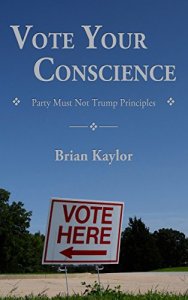
If you are Christian, particularly an evangelical Christian, this book has some things we need to hear. In the later chapters Kaylor spells out some basic truths for us: for too long we have wed our political platforms with our faith (to the detriment of our faith) and our allegiance is to the Kingdom of God, not a nation or a political party. If I could come to your house and read those couple chapters to you, I would. And I may. My biggest concern for this book is that those messages will be lost on people who don’t make it past the author describing why he feels their preferred candidate is morally suspect, which happens in the first couple chapters.

The basic thesis of the book is this, “We do not owe our chief loyalty to the Republican Party or the Democratic Party. Our devotion is not to conservative causes and politicians or liberal causes and politicians. Our allegiance is to the Kingdom of God. We don’t follow the elephant or the donkey; we follow the Lamb.”

Amen.

Kaylor’s concern (one I completely resonate with) is that many Christians have given our preferred political parties our first allegiance. We have been looking for a savior from Washington DC and we often “sell our birthright for a bowl of red (or blue) stew.” He says too many of us are willing to blindly follow a party leader over the principles of our faith or even our basic political leanings. This book is a call to remember what we believe and then align how we vote behind those values, not realign our values based on how we may have to vote.

Kaylor lays out an argument as to why he feels both Hillary Clinton and Donald Trump are morally unfit to be president of the United States. He clearly states he does not support Ms. Clinton and presents a case against her, but spends most of his time arguing against Mr. Trump. He, like myself, is deeply rooted in white, conservative, evangelical circles. When he spends a disproportional amount of time speaking about Trump he does so because the people he is most familiar with are disproportionally more likely to support the GOP candidate.

I find his moral arguments convincing, though those who are deeply entrenched in support behind one candidate or the other will not be quick to hear them. He calls out a number of conservative Christians and politicians for what he thinks is dangerous capitulation to a person who doesn’t represent their stated values or even basic levels of human decency. He calls out Trump for his misogyny, racism, religious intolerance, and general behavior. He says that to support a candidate who acts and believes in those ways is the same as holding those positions ourselves. That will be a tough pill to swallow for many people. At times his sarcasm and frustration may put people on the defensive.

But again, the overarching message of the book is worth the read. If you don’t want to hear about why you shouldn’t vote for Clinton or Trump, just skip to Chapter 3. At the end he includes a chapter on what to do in response to these two major party candidates and some ideas for how Christians can rise above partisan rhetoric for the sake of the Kingdom.

I join Kaylor in his concern that the work and witness of the Church is being hindered as we line up behind morally bankrupt politicians and alienate people who vote or feel differently than we do. He beautifully says, “We are called to avoid the temptations of power. We’re called to avoid joining the team just because it’s the winning side. We’re called to stand on the margins, prophetically proclaiming the truth.”

I absolutely recommend this book and encourage you to grab a copy today. You will at least become more informed and perhaps you will be more faithful to the work of the Gospel because of it.


What If God Doesn’t Want to Make America Great Again?


2016-07-16 14.16.41

Recently I received an email stating that if Christians don’t support Donald Trump for president we can “kiss our country goodbye.” It said something to the effect of, “Sure he isn’t all that decent, but if that’s what it takes for our economy to be strong, our borders to be secure, and our nation to be great, then so be it.” It suggested God sent us Trump to preserve our capitalism, our patriotism, and general way of life; that perhaps Trump is God’s tool to save our country.

I’m not going to comment on whether any of that is accurate or not, but the email did get me thinking…

What if God doesn’t want to Make America Great Again? Or maybe, what if God’s definition
of great looks a lot different than what many of us are hoping for? What if saving our country (whatever is meant by that) is not really what God has in mind?

I’m not saying that God wants to see America destroyed, but I’m wondering if we make some false assumptions when we think God wants us rich and safe or whatever other things people mean when they say they want America to be great again.

Set aside the fact that many of us will disagree on what actually makes our country great and consider why we think God wants us wealthy, secure, and politically free. Jesus was none of the above. Nor were his first disciples or the early church or many Christians around the world today. None of those things are promised to us. None of those things are neccessary to live a faithful life.

Have we become so attached to our stuff that we are certain God wants us to keep it? Have we become so accustomed to having a vote that we assume that’s how God orders the world? Are we so desperate for security that we are willing to compromise our most basic values to acheive it? And so opposed to our enemies that we are confident God hates them as much as we do?

If so, we are misguided. These things do not line up with the Gospels where I learn of a Jesus who says to welcome the stranger, forgive extravagantly, give radically, and do not resist an evil person (and love them instead). A Jesus who erases cultural and political and religious divisions.

Jesus who flat out says, “Whoever wants to be great needs to become a servant of everybody else.

But we have little time for that sort of greatness. “Be A Servant” isn’t an attractive campaign slogan. Not when we have elections to win and businesses to boycott and borders to secure. Jesus says his Kingdom is not of this world, but we would say our kingdom certainly is and, well, all that loving and forgiving stuff works in church, but this here is the real world.

And so we declare our allegiance. We choose earthly greatness and power and success and security over the way of the cross. We justify our lack of loving our neighbors because we have to protect our version of the American dream.  We cling to political liberty at all costs and find ourselves chained to platforms and politicians.

I’m not anti-American. I’m not an anarchist. I plan to vote in the coming election. I’m just not going to assume that God’s deepest desire for us is something as fleeting as prosperity or political freedom. I’m not convinced God is hoping we elect the proper candidate so he can finally get to work in our country.

While I strongly believe in “life, liberty, and the pursuit of happiness” and want those things for all people (literally, all the people), I am not dependant on them. Nor do I think those are the highest things a person can acheive.

Not when our Savior started life as a refugee, lived under the military occupation of his enemies, spent his ministry years homeless, and was persecuted to the point of execution.

Not when the majority of our Scriptures were written to or about people with no freedom, no security, and no wealth. Peope who often neglected their faith whenever they had actually attained those very things.

And not when many of us are willing to ignore the teachings of Christ in order to make a nation great. If I can’t make America great by living the way of Christ, then I want no part in that greatness. And I don’t think God does either.

If we live and love like Jesus of Nazareth at the expense of privilege or safety, I believe America (and the rest of the world) will be greater because of it. Not because we have accumulated all the power and all the wealth, but because we have been faithful. Because being faithful to the way of Jesus is the only way to be truly great.

So inform yourself and vote if you feel so led. But long before and long after your ballot is cast, consider what things you are grasping for, what things motivate and excite you, and what things you assume God wants for you. And then compare them to the life of Jesus.

I imagine we will find we have spent a lot of time and money and energy and yard signs on a greatness that is at best temporary and at worst idolatry. We’ve been invited to something better than anything a politician can offer and we’ve been charged to live in such a way that it doesn’t ultimately matter where we reside or what we possess.

May we be faithful first. Even when the alternative sounds safer and more comfortable. May we choose Jesus and his cross today and every day. Even when it costs us elections and political power. And may we see the world become as great as its ever been.


On Being Afraid of the Wrong Things.

There are a lot of things I fear. Like windows without blinds (seriously) and heights.

And there are a lot of things I do not fear. Fear Ladder

Like Muslims.

I’m also not afraid of Buddhists or scientists or flying spaghetti monsters.

I’m not afraid of questions or doubt or skepticism.

I’m not scared of any government or capitalist or communist. I’m not even afraid of Trump.

I’m not afraid of refugees or illegal immigrants or legal ones.

I do not fear gay people or trans people or people we can’t categorize in neat and tidy ways.

Along the same lines, I’m not afraid of finding someone in the “wrong” bathroom. I’m just not.

I’m not afraid of political correctness or laws that make room for other people’s belief systems.

I’m not afraid of the super rich or the desperately poor, people on welfare or people in penthouses.

In my greatest moments I’m not even scared of those who wish me harm or those who tell me I’m wrong.

I do my best not to be afraid of people who don’t look like me, act like me, speak like me, or believe like me.

I am, however, afraid of the way I and others like me misrepresent Jesus. I’m afraid people may reject Jesus because they see me and decide if this is what Jesus is about, they want no part of it.

I’m afraid the Kingdom of Me is a whole lot more appealing than the Kingdom of God. I fear that I seek first my reputation and status and rights. I’m scared to think that I would chose safety and security or comfort and complacency over faithfulness.

I’m afraid our commitment to political opinions is stronger than our willingness to “love your neighbor as yourselves.” I’m afraid that our quest for power and position and privilege leaves us overlooking the very people for whom Jesus would be most concerned.

I’m afraid I don’t have enough friends who are prostitutes or tax collectors. I’m fearful I exclude outsiders and those whose lives look messy. I’m afraid I too easily look down on or insult those who look, act, and believe differently.

I’m afraid all our boycotts and clever memes and FWD: FWD: FWD: emails (and blog posts) will do nothing to bring about the world God desires. I’m fearful that we’ve traded Good News for bad news, an eternal perspective for a temporary one.

I’m afraid that I desire to be right more than I desire to be loving.

I’m afraid that when we respond in fear to people, politics, religions, and whatever things are different than us, we are not responding in the way of Christ. I’m afraid that fearing “the other” will leave me only loving myself.

Most of all I’m scared I will raise my kids to be afraid of the people they are called to love. I’m afraid I will so want to save my children’s lives that they will lose the only life that matters in the process.

That terrifies me far more than terrorism does.

As a general rule I avoid ladders and roofs and other things from which the greedy hands of gravity wish to remove me. My discomfort with heights is stronger than my desire to have clean gutters. My fear wins out.

Since fear often determines my behavior I want be sure to fear the right things.

I want to avoid division and exclusion. I want to build bridges, not walls. I want to learn from people who see things differently. I want to hear the stories of those I don’t understand. I want to break bread with people who have dreams and fears of their own; people who have value to my God. 

I long to set aside things I want in order to serve and love the people everyone else seems to fear. I don’t want any part of pushing people away because they vote or live or believe differently than I do. I want less of “us and them” and just a whole lot of “us.”

When we do that we’ll all be better for it. When we do that we’ll look more like Jesus, who fears none and loves all. And I believe when we look more like Jesus everything changes. And when everything changes, there will be nothing left to fear.