Have Mercy On Me, a Sinner

2017-03-01-11-56-03

What we think of ourselves says a lot about how we approach God and how we treat others. In the Gospel of Luke Jesus uses a story of two men at the Temple praying in order to teach us a thing or two along those lines.

One of the men is a Pharisee. He is devout and schooled in theology. He knows the Scriptures in and out. He has mastered the disciplines of his faith. He knows he is good.

His prayer is a picture of self-righteousness, “Thank God I’m not like everyone else.”

The other man is a tax collector. He is considered a traitor to his people and his faith. He gets rich working for the bad guys while lining his pockets with the neighborhood’s money. He is despised. He knows he is broken.

He prays from a place of humility and contriteness, “O God, have mercy on me, a sinner.”

Jesus explains it is this man, not the “good” one, who leaves the Temple right with God.

Now sometimes us church folk fall into the category of Pharisee. We start thinking we are better or more holy than others because we do the right things or avoid the wrong ones or at least don’t do them as much as other people. The problem with the Pharisee’s prayer is not that it isn’t true, but that it is built on what he has done and dripping with pride.

This mindset is graceless. Here being right with God is about behavior modification. Here we forget we need God just as much today as we did at our lowest point. And here we become hypocritical judges in our assessment of everyone else. We reassure ourselves of just how good we are and miss out on God’s work in our lives and transformational relationships with people around us.

This is a dangerous place to live.

There is another mindset that isn’t mentioned in the parable but is prevalent in our culture. Sometimes we model a similar prayer, “Thank God I am just like everyone else.”

Here we aren’t bothered by our brokenness, we are just glad we aren’t the only ones experiencing it. We excuse our behavior/thoughts/attitudes because everyone else seems to be on the same page and, hey, we’re just human after all. Here the idea isn’t to elevate ourselves over tax collectors, but to lower the bar for what is required of us.

We like being broken, so we don’t change. We rest in the comfort of knowing there are other broken people, so we don’t want to see them change.  We enjoy our sin. Or perhaps its too hard to resist so we’ll just stay right where we are.

This too is a dangerous place to be. Here we find cheap grace. Cheap grace is as useless as no grace.

The only proper approach is that of that tax collector. It is here we realize how much work needs to be done in us. That scandalous sinner or pious preacher, I need God. It is here we see regardless of how good or bad our behavior is we must have mercy.

Change without mercy is fine, but cannot save anyone. Mercy without change is easy, but meaningless. Mercy, when experienced with a humble heart, has the power to bring about change in us.

This is the mindset the Church is to have: acknowledging our need of mercy and allowing mercy to transform us.

That means more than mouthing these words in prayer, but allowing this understanding to shape us through and through. We are to embody this concept in attitude and action. It should guide the way we take inventory of our hearts. It should affect the way we approach our neighbors and our God.

O God, have mercy on me, a sinner.

May these words be on our lips and in our heart. May we pray them and live them. May we be humble and contrite. And may we find the mercy we so desperately need.

To My Non-Christian Friends This Election Season

To My Non-Christian Friends, dearfriends_black

This election season has been something else, huh? (Here is a video of puppies if you need something to cheer you up.) Take heart, it is almost over. We have at least until February before people start openly campaigning for 2020.

In the meantime, I’d like to say something to you. Specifically, I’d like to say sorry. I think you have seen us Christians at our worst lately and for that I apologize.

I’m sorry that you’ve seen so much fighting between us. We can be brutal to each other and we call ourselves family. We fire missiles from all sides of the aisle and don’t worry too much about collateral damage. It probably isn’t very inviting when we behave this way. I’m sorry if you are less likely to want to be around us after all this.

I’m sorry that you’ve probably gotten into a debate or two with one of us. I’m sorry that we don’t often fight very graciously. I’m sorry that we stoop to things like name calling and rapid dismissal.

I regret that we often want to be heard, rather than hear. That isn’t very kind of us.

I’m sorry if you were unfriended because of your political views. I’m sorry we value our opinions more than your friendship. I’m sorry that we let partisanship get in the way of relationship. There are things we will all never agree on, but that shouldn’t stop us from sharing meals and photos of our kids and life in general.

I’m sorry that you see us defending things that are indefensible. Things Jesus would oppose. Things we have routinely and loudly condemned. I’m sorry that we hold a double standard so that we can excuse our candidates and condemn someone else’s. That’s not consistent and its certainly not Christlike.

I’m sorry for all the false memes and bunk articles we have posted. We don’t think very highly of lying, but we are at times in such a rush to be right we fail to check our information. That isn’t very good of us.

I’m sorry if we have led you to believe that a person’s eternal destiny hinges on how they vote. We don’t actually believe that, though we sometimes act and preach like it. Sometimes we (rightly or wrongly) put a lot of hope and energy into these things, but if you give us a time to catch our breath we will remember it is grace, not ballots, that save us.

We sing a song that says our hope is built on nothing less than Jesus. I’m sorry we haven’t acted that way lately. While we want to have a say in government, ultimately our hope is not in presidents and senators and legislation.

I’m sorry if you’ve been hurt by the way we talk about the candidates and their supporters. Regardless of politics you and they are loved and cherished by God. We’ve failed to reflect that too often. That grieves me.

I apologize that regardless of which side we are on, we are often unable to understand where you are coming from. I’m sorry if we talk down to you or figure you couldn’t possibly know or have hurt you with our assumptions.

I know it is probably hard to see through all the nonsense, but Jesus is better than we represent. I’m not sure of a lot of things, but I’m absolutely positive of that. I’m sorry if we have failed him and you this election season.

If we are honest we are just regular ole humans. We mess up, we don’t always do what we want. We can be too passionate, we can be misguided, we can be flat wrong. Please don’t hold that against Jesus.

I can’t speak for all of us, but I can speak for me. I would trade in all this election stuff if it meant people would be more likely to consider following Jesus. His ways are better. We have a saying that goes like this, “His grace is sufficient.” The grace of God is sufficient to cover our weakness and our mistakes. We greatly depend on that.

Now I’m asking for grace from you. Please forgive us for our actions and attitudes, our words and our compliance. Please forgive us for pointing you toward a political party more than Jesus. Please forgive us when we cross the line, wound others, or look no different than any other person you know.

We are supposed to do better than that. We have been wrong. Maybe not all of us, but some of us, including me. And I’m sorry.

What Kaepernick, Immigrants, Republicans, and You Have In Common

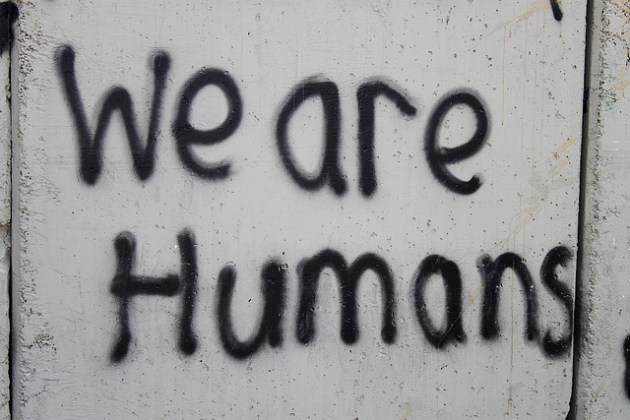
humans.jpg

source: generationnblog.wordpress.com

There have been several stories in the news over the past few days that have bothered me:

I have this question: What is wrong with us? How has this become the way we respond to people who are different? It isn’t that we are just so passionate or a little too polarized. These things speak to a lack of decency and a seemingly increasing inability to see value in other people. This is not okay and we need to reconsider some things to bring it a stop.

So let’s start with the basics.

What do Colin Kaepernick, Republican campaign workers, and Somalian refugees have in common? They are human beings. Just like the people who responded to them in evil ways.

And being a human means a few things. It means they are someone’s son or daughter. They could be someone’s mother or father, aunt or uncle, brother or sister, grandfather or friend. They are loved by people. They matter to somebody. They are connected to others.

Being human means they have hopes and dreams and fears. They have plans for their kids. Their dogs are counting on them to be home in time to let them outside. They have projects around the house that need attention. They hate when their cereal gets soggy. They have seasonal allergies. They are real people.

We have to remember that everyone is a person first. It seems simple, but it’s not.  They are a person before they are a statistic, before they are a candidate, before they are a Christian or a Muslim, before they are “all that is wrong with America today.” They are flesh and blood, heart and soul, people.

They may make you irate, they may do things you consider immoral, they may vote from opposite worldviews, and they may be different than you in every way, but they are people. Which means you have something in common with them. If we can start with our common humanity, perhaps we can begin to move toward something better than hate and division.

In the book To Kill a Mockingbird Scout quips, “I think there’s just one kind of folks. Folks.” Her brother dismisses her as young and naïve, but I think she is on to something.

There are a lot of ways I may be different from another person. Religion, politics, economics, culture. Some of those differences are things I am not able to set aside. I can’t or won’t change who I am in a lot of ways. For instance, I will never be a New York Yankees fan. This is unthinkable. I have principles. But it doesn’t mean that I have to reject the humanity of those who support that team. They are folks just like me.

Despite our differences, we share something first. And it’s not just that we share tangible things like skin and bones, but there is something deeper that connects us all and informs the way we should treat one another.

The Scriptures say that people are made in the image of God. All people. Not just a select few, not just the ones with the right beliefs. All of them. It extends to all political parties and sports fans and nationalities. It crosses religious divides and language barriers and class systems. If you are human, you bear the image of God.

So I can’t hate you. We have too much in common. We are image bearers. We are people. All of us. And people are meant to be loved.

For me and my tribe, the followers of Jesus, this is not optional. Not one bit. Even if we are confident that protesters and party leaders and immigrants are the enemy, Jesus says to love them anyway. In fact, the more we are convinced they are the enemy, the more our love toward them should grow. That is the way of Jesus.

I believe the more we look at our story, the more we see all the things we share universally. For all have sinned. For God so loved the whole world. Good news of great joy for all people. There is plenty here for us to build on.

So let us start with what we have in common. Let’s start with the fact that we are people. We are all folks. Even when we are different, even when we disagree, even when we are confident we are in the right.

We have got to do better. We have to refuse to be part of the continued dehumanization of “the other.” We cannot allow our world to be a place where people are hated or dismissed or hurt because they vote differently or worship differently or think differently or have a different skin color. We have far too much in common for that to continue.

You and I must remember our shared humanity with the people on the news and the people across town and the people around the world. We share something with the person who is driving much.too.slowly when you are in a hurry. With the waiter who is neglecting your long empty sweet tea. We share some things in common with the annoying guy at work. With refugees and Democrats and The Donald. With the people we don’t understand. With our neighbors.

They are human. Just like you. They aren’t perfect. Just like you. They have experiences and stories. They have hopes and fears. Just like you. They aggravate someone. Just like you. They are made in the image of God. Jesus died for them. They are meant to be loved. Just like you.

Let’s start there and see if we can’t make this world a better place for everyone. Let’s set aside as much “us and them” language as we can and stick to the things that make us “us.” Let’s see the shared humanity in everyone we meet.