When We Disagree.

disagree

Photo Source: conferencecalling.com

One of the blessings and/or curses of social media is that everyone has a voice. You get a voice, I get a voice, your crazy uncle gets a voice. And since everyone has a voice, somewhere on the internet somebody is wrong right this second. They are going to vote for the wrong candidate or they don’t value your religious convictions or they think the Dallas Cowboys are a team worth supporting.

The chorus of voices is diverse and our opinions are many and yet it seems to me that we have lost the ability to disagree well. We insult and antagonize. We jump to conclusions and fight straw men. We even go ALL CAPS when feeling particularly saucy.

Every issue is now politicized and our ability to find common ground is stunted. We make enemies out of people who hold differing views or experiences. We dehumanize ourselves and others simply because we disagree. And amazingly, despite all the venom we spew and seemingly conclusive facts we vomit, we change not a single opinion.

We can (and should) debate and be passionate, but we need do it with decency and mutual respect. We don’t have to hate each other just because we don’t agree. We don’t have to make it our personal mission to correct or rebuke every wrong person we encounter.

It is time we recover some civility in the midst of disagreement.

Which means we need to hear the other side. Not just take in their words, but actually process what they are saying. Why do they hold the positions they hold? How did they come to that conclusion? What experiences have brought them to this point?

It is easier to just unfriend or unfollow people. It is easier to watch only the news channel that reports from our preferred angle. To dismiss alternate opinions and brush aside any information contrary to what we already believe.

The consequence is we end up living in an echo chamber where the only voices we hear are the ones that sound like ours. This makes us more polarized and deteriorates our capacity to understand people who think differently than we do. We are in trouble if we are so convinced we are right that we can’t even allow other opinions to show up in our newsfeed or on our cable news station. This is a weakness, not a strength.

If we are going to disagree well we will need to listen, actually listen, to what every side has to say. We will be better for it. Our own positions will be strengthened as we learn what others believe and perhaps our well-roundedness will gain us credibility.

If we are going to disagree like adults we will need to stop villainizing people simply because we don’t see eye to eye. I may disagree with you but it doesn’t mean I hate puppies or sunshine or your children. We can do without that nonsense. We may not come to the same conclusions about how taxes should be spent, but I don’t think either of us is trying to destroy our country.

Disagreeing with me doesn’t make you a Neanderthal/jerk/heretic/Nazi/communist/whatever-your-scariest-insult-is. It just makes you wrong. Using blanket statements and hyperbolic terms will get us nowhere. A person is not an idiot just because they have the audacity to disagree with you or me. Sitting behind our keyboards and slinging mud and insults at people we don’t have to look in the face is the cheap way out.

This is not how the real world works. We have to cooperate and live and work and study and worship with people who may disagree with us on any number of issues. They are our friends and spouses and bosses and neighbors. If there is no one in our lives who disagrees with us, we are missing out on meaningful relationships while at the same time not having any influence on people who see the world differently.

If we are to disagree well, we need to be realistic. We need to understand we won’t change everyone’s mind and agreeing to disagree is okay in most situations. We are not likely to convince a person that the positions they’ve held for decades are ignorant and no thinking person would ever come to such conclusions. Some opinions are incredibly complex and have been formed over much time and thought.

Be heard, be prepared (and be kind for crying out loud), but don’t expect a pithy statement or even a heartfelt plea to change someone’s mind. When is the last time an argument in the comment section convinced you that you were wrong? People have been arguing about the things we argue about for a long time. There are smart and caring people on many sides of many issues.

We can do better.

We can be humble. We can sometimes keep our mouths closed and fingers still. We can remember that compromise and finding common ground is not caving. We can think critically. We can allow for others to freely share what they believe. We can learn. We can listen. We can avoid attacking the other person. We can respect and love and esteem each other as fellow human beings. And still disagree.

Disagreeing isn’t the problem. The way in which we disagree will determine much of what we contribute to the world. Are we adding to the discord and division that needlessly rules the internet? Or are we voices of reason and people of respect and decency? Do we sow peace and love or discord and hate?

Let’s be right and wrong with a heaping scoop of decency. Let’s disagree well. Or at least better than we have been recently. Can we at least all agree on that?
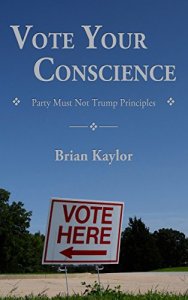
Book Review: Vote Your Conscience

— I was provided with a copy of the new book Vote Your Conscience: Party Must Not Trump Principle by Brian Kaylor in exchange for an unbiased and fair review.- –

Vote Your Conscience is a quick read at just six chapters long. It is $2.99 for Kindvote bookle at the time of this writing. The Amazon blurb includes this, “In this book, award-winning author Brian Kaylor addresses the moral issues at stake in the 2016 election, explores how the Christian faith became too closely tied to partisan politics, and considers the alternative political engagement called for in scripture.”

If you are Christian, particularly an evangelical Christian, this book has some things we need to hear. In the later chapters Kaylor spells out some basic truths for us: for too long we have wed our political platforms with our faith (to the detriment of our faith) and our allegiance is to the Kingdom of God, not a nation or a political party. If I could come to your house and read those couple chapters to you, I would. And I may. My biggest concern for this book is that those messages will be lost on people who don’t make it past the author describing why he feels their preferred candidate is morally suspect, which happens in the first couple chapters.

The basic thesis of the book is this, “We do not owe our chief loyalty to the Republican Party or the Democratic Party. Our devotion is not to conservative causes and politicians or liberal causes and politicians. Our allegiance is to the Kingdom of God. We don’t follow the elephant or the donkey; we follow the Lamb.”

Amen.

Kaylor’s concern (one I completely resonate with) is that many Christians have given our preferred political parties our first allegiance. We have been looking for a savior from Washington DC and we often “sell our birthright for a bowl of red (or blue) stew.” He says too many of us are willing to blindly follow a party leader over the principles of our faith or even our basic political leanings. This book is a call to remember what we believe and then align how we vote behind those values, not realign our values based on how we may have to vote.

Kaylor lays out an argument as to why he feels both Hillary Clinton and Donald Trump are morally unfit to be president of the United States. He clearly states he does not support Ms. Clinton and presents a case against her, but spends most of his time arguing against Mr. Trump. He, like myself, is deeply rooted in white, conservative, evangelical circles. When he spends a disproportional amount of time speaking about Trump he does so because the people he is most familiar with are disproportionally more likely to support the GOP candidate.

I find his moral arguments convincing, though those who are deeply entrenched in support behind one candidate or the other will not be quick to hear them. He calls out a number of conservative Christians and politicians for what he thinks is dangerous capitulation to a person who doesn’t represent their stated values or even basic levels of human decency. He calls out Trump for his misogyny, racism, religious intolerance, and general behavior. He says that to support a candidate who acts and believes in those ways is the same as holding those positions ourselves. That will be a tough pill to swallow for many people. At times his sarcasm and frustration may put people on the defensive.

But again, the overarching message of the book is worth the read. If you don’t want to hear about why you shouldn’t vote for Clinton or Trump, just skip to Chapter 3. At the end he includes a chapter on what to do in response to these two major party candidates and some ideas for how Christians can rise above partisan rhetoric for the sake of the Kingdom.

I join Kaylor in his concern that the work and witness of the Church is being hindered as we line up behind morally bankrupt politicians and alienate people who vote or feel differently than we do. He beautifully says, “We are called to avoid the temptations of power. We’re called to avoid joining the team just because it’s the winning side. We’re called to stand on the margins, prophetically proclaiming the truth.”

I absolutely recommend this book and encourage you to grab a copy today. You will at least become more informed and perhaps you will be more faithful to the work of the Gospel because of it.

What If God Doesn’t Want to Make America Great Again?


2016-07-16 14.16.41

Recently I received an email stating that if Christians don’t support Donald Trump for president we can “kiss our country goodbye.” It said something to the effect of, “Sure he isn’t all that decent, but if that’s what it takes for our economy to be strong, our borders to be secure, and our nation to be great, then so be it.” It suggested God sent us Trump to preserve our capitalism, our patriotism, and general way of life; that perhaps Trump is God’s tool to save our country.

I’m not going to comment on whether any of that is accurate or not, but the email did get me thinking…

What if God doesn’t want to Make America Great Again? Or maybe, what if God’s definition
of great looks a lot different than what many of us are hoping for? What if saving our country (whatever is meant by that) is not really what God has in mind?

I’m not saying that God wants to see America destroyed, but I’m wondering if we make some false assumptions when we think God wants us rich and safe or whatever other things people mean when they say they want America to be great again.

Set aside the fact that many of us will disagree on what actually makes our country great and consider why we think God wants us wealthy, secure, and politically free. Jesus was none of the above. Nor were his first disciples or the early church or many Christians around the world today. None of those things are promised to us. None of those things are neccessary to live a faithful life.

Have we become so attached to our stuff that we are certain God wants us to keep it? Have we become so accustomed to having a vote that we assume that’s how God orders the world? Are we so desperate for security that we are willing to compromise our most basic values to acheive it? And so opposed to our enemies that we are confident God hates them as much as we do?

If so, we are misguided. These things do not line up with the Gospels where I learn of a Jesus who says to welcome the stranger, forgive extravagantly, give radically, and do not resist an evil person (and love them instead). A Jesus who erases cultural and political and religious divisions.

Jesus who flat out says, “Whoever wants to be great needs to become a servant of everybody else.

But we have little time for that sort of greatness. “Be A Servant” isn’t an attractive campaign slogan. Not when we have elections to win and businesses to boycott and borders to secure. Jesus says his Kingdom is not of this world, but we would say our kingdom certainly is and, well, all that loving and forgiving stuff works in church, but this here is the real world.

And so we declare our allegiance. We choose earthly greatness and power and success and security over the way of the cross. We justify our lack of loving our neighbors because we have to protect our version of the American dream.  We cling to political liberty at all costs and find ourselves chained to platforms and politicians.

I’m not anti-American. I’m not an anarchist. I plan to vote in the coming election. I’m just not going to assume that God’s deepest desire for us is something as fleeting as prosperity or political freedom. I’m not convinced God is hoping we elect the proper candidate so he can finally get to work in our country.

While I strongly believe in “life, liberty, and the pursuit of happiness” and want those things for all people (literally, all the people), I am not dependant on them. Nor do I think those are the highest things a person can acheive.

Not when our Savior started life as a refugee, lived under the military occupation of his enemies, spent his ministry years homeless, and was persecuted to the point of execution.

Not when the majority of our Scriptures were written to or about people with no freedom, no security, and no wealth. Peope who often neglected their faith whenever they had actually attained those very things.

And not when many of us are willing to ignore the teachings of Christ in order to make a nation great. If I can’t make America great by living the way of Christ, then I want no part in that greatness. And I don’t think God does either.

If we live and love like Jesus of Nazareth at the expense of privilege or safety, I believe America (and the rest of the world) will be greater because of it. Not because we have accumulated all the power and all the wealth, but because we have been faithful. Because being faithful to the way of Jesus is the only way to be truly great.

So inform yourself and vote if you feel so led. But long before and long after your ballot is cast, consider what things you are grasping for, what things motivate and excite you, and what things you assume God wants for you. And then compare them to the life of Jesus.

I imagine we will find we have spent a lot of time and money and energy and yard signs on a greatness that is at best temporary and at worst idolatry. We’ve been invited to something better than anything a politician can offer and we’ve been charged to live in such a way that it doesn’t ultimately matter where we reside or what we possess.

May we be faithful first. Even when the alternative sounds safer and more comfortable. May we choose Jesus and his cross today and every day. Even when it costs us elections and political power. And may we see the world become as great as its ever been.